fast-anything 找出程式中最慢的部分,只把它改寫成 Rust
Fast-Anything: Don't rewrite it in Rust. Rewrite the 5% that's slow
整個程式改用 Rust,可能要花上好幾個月;fast-anything 的做法是先找出最花時間的函式,只把那部分改寫成 Rust。
- 它會記錄程式實際收到的呼叫,再逐一比對新舊版本的結果。
- 結果相同而且執行更快,才會啟用改寫版本,也能隨時切回原本程式。作者列出的實測中,Python 模糊比對 700 個名稱從 4.91 秒降到 42 毫秒。
- 這些數字來自文中指定的電腦與執行環境。
AI 伴隨問答
針對這篇報導有疑問?可直接點選快捷問題或向 AI 追問背景脈絡與技術細節:
這個工具會先找出耗時較多的函式,再用實際呼叫比對 Rust 版本的結果,呈現區域性改寫的做法與檢查方式。

Don't rewrite it in Rust. Rewrite the 5% that's slow.

Rewriting a whole app in Rust costs months, minute-long compiles and gigabytes of target/. Most of the runtime sits in a few functions anyway.
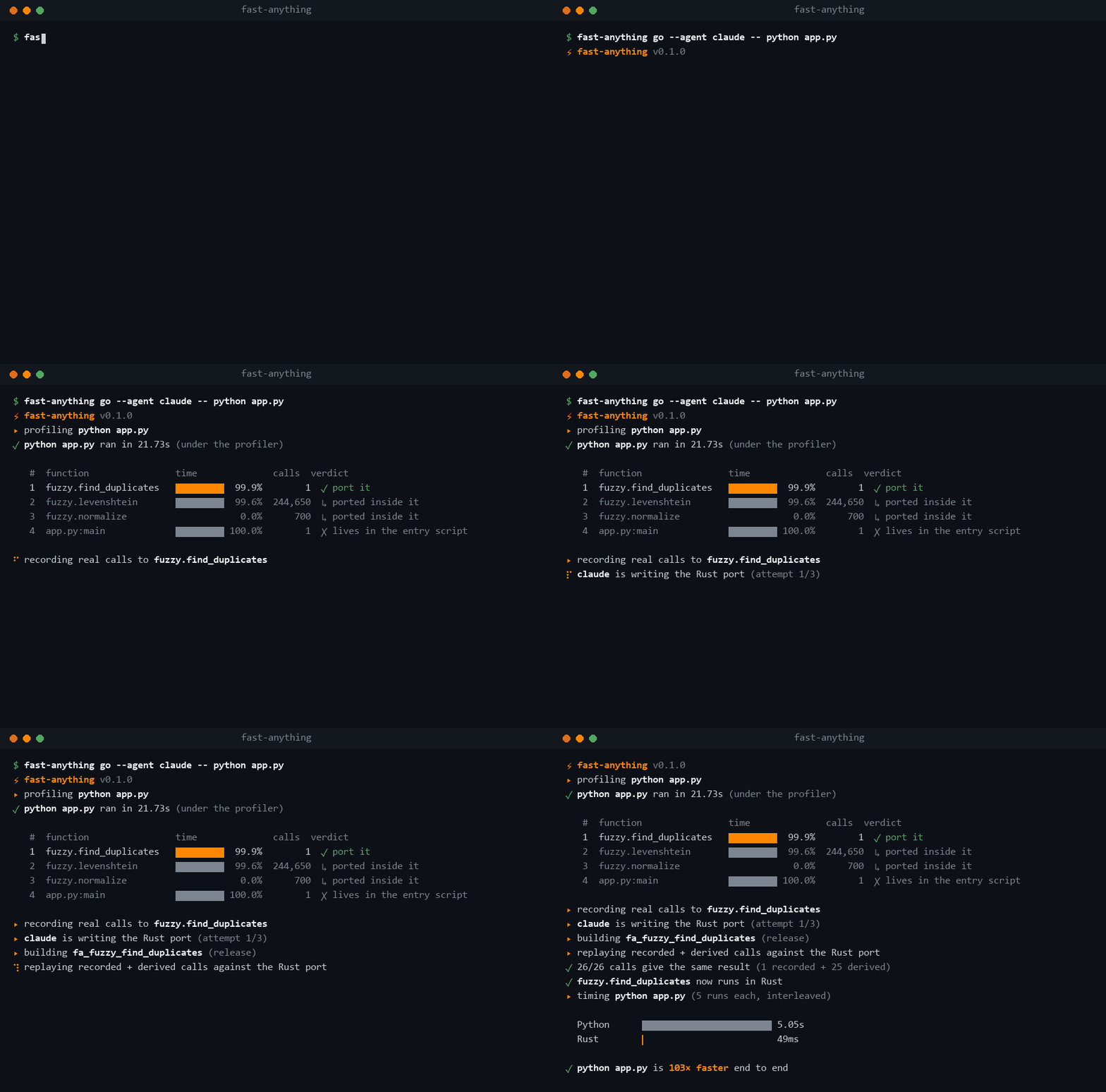
fast-anything finds those functions, has your coding agent port only them to Rust, proves the port gives the same results on real recorded calls, and swaps it in. One command, fully reversible.
Install
npm i -g @el4cteo/fast-anything # or: cargo install fast-anythingPorts are compiled with your Rust toolchain (rustup).
Use
fast-anything go --agent claude -- python app.py # or: -- node app.ts / bun app.ts / deno run -A app.ts / ruby app.rb / java App.java / mvn exec:java / gradle run / go run . / php app.php / clang -O2 main.cOr step by step:
| command | what it does |
|---|---|
scan -- <cmd> |
profiles the app, ranks functions by time × how portable they are |
port [id] |
records up to 500 real calls, creates a one-function Rust crate + TASK.md |
verify |
release-builds the port and replays every recorded call |
enable / disable |
swaps the Rust in or out (one marked block, removed byte for byte) |
bench |
times the whole app, original vs Rust, interleaved runs |
report |
markdown + SVG card for your PR |
doctor |
checks Rust, your runtimes and your agents |
--agent takes claude, codex, or any command that reads a prompt on stdin. Without it, hand TASK.md to whatever you use.
Proof, not vibes
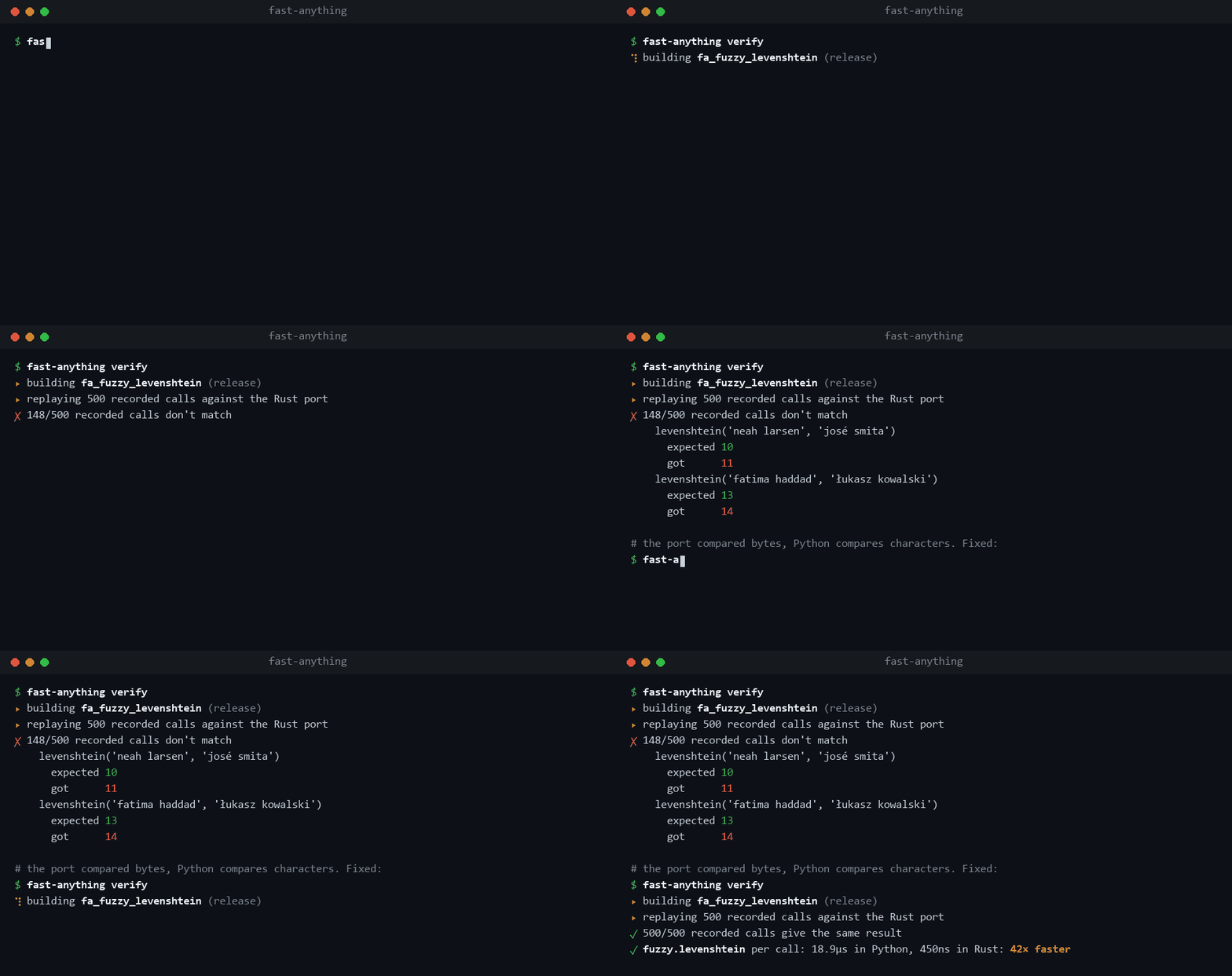
That port looked right but compared bytes instead of characters. 148 of 500 real calls caught it. On top of the recorded calls, fast-anything derives extra cases and lets the original answer them: edge cases (NaN, ±infinity, -0.0, zero and ±1, non-ASCII text, empty and up to 16× bigger inputs) and shrunk inputs (tiny and random slices). Nothing is enabled until every case matches: same values (floats within 1e-9), errors where the original errors. A port that is right but slower per call than the original (calling into Rust costs more than the work saved) isn't enabled either. FAST_ANYTHING_DISABLE=1 runs the original any time.
Results
Real runs on an i5-10500, Windows 11 (C and C++: a 4-core GitHub Actions Linux runner). Reproduce them from examples/.
| app | before | after |
|---|---|---|
| Python fuzzy dedupe (700 names) | 4.91s | 42ms, 116× |
| TypeScript fuzzy dedupe (2,000 names) | 3.11s | 155ms, 20× |
| PHP fuzzy dedupe (600 names) | 2.94s | 53ms, 55× |
| Go fuzzy dedupe (3,000 names) | 3.02s | 144ms, 21× |
| Ruby fuzzy dedupe (400 names) | 3.13s | 228ms, 14× |
| C# fuzzy dedupe (4,000 names) | 4.03s | 312ms, 13× |
| Java fuzzy dedupe (4,000 names) | 3.50s | 1.18s, 3× (11× on the function; the rest is JVM startup) |
| C mandelbrot (8 zoom levels) | 431ms | 127ms, 3.4× |
| C++ fuzzy dedupe (6,000 names) | 3.02s | 1.09s, 2.7× |
fast-anything ports the outermost loop it can, not the tiny function called inside it, so the app crosses into Rust once instead of millions of times. Porting only the inner levenshtein gave 35× and 1.9×.
Why not rewrite it all?
- Compile time: each port is a one-function crate. Seconds, not minutes.
- Cache: every port shares one
.fast/target. Delete it whenever you like. - Risk: your code stays as it is. Rust is opt-in per function, checked against real behavior.
Agents
- Claude Code plugin:
/plugin marketplace add EL4CTEO/fast-anything, then/plugin install fast-anything@fast-anythingand/fast-anything:fast python app.py - MCP server (Claude Code, Codex, Cursor…), built into the binary:
claude mcp add fast-anything -- fast-anything mcp. 8 tools:fast_scan,fast_port,fast_verify,fast_enable,fast_disable,fast_bench,fast_report,fast_status. - Skill:
skills/fast-anythingteaches any agent the loop.
Languages
| language | binding | status |
|---|---|---|
| Python 3.10+ | PyO3 | ✅ |
JavaScript / TypeScript (Node 22+, Bun, Deno 2+: bun app.ts, deno run -A app.ts) |
napi-rs | ✅ |
| Ruby 3.3+ | C ABI + JSON, through Ruby's built-in Fiddle | ✅ |
Java 22+ (java App.java, Maven, Gradle) |
the same C bridge, through the FFM API | ✅ |
Kotlin/JVM (Gradle, src/main/kotlin, JDK 22+) |
the Java bridge; top-level functions, object and companion members, extension functions |
✅ |
Go 1.22+ (go run .) |
the same C bridge, through the Windows loader or dlopen (cgo) | ✅ |
PHP 8.1+ (php app.php) |
the same C bridge, through PHP's FFI extension (extension=ffi) |
✅ |
C and C++ (gcc, clang or Intel oneAPI icx/icpx: clang -O2 main.c lib.c) |
the same C bridge, through LoadLibrary or dlopen | ✅ |
C# / .NET 8+ (dotnet run -c Release) |
the same C bridge, through NativeLibrary; profiled with EventPipe, nothing to install | ✅ |
It ports top-level, deterministic functions that take plain data (numbers, strings, lists, dicts, typed arrays…), including ones in your entry script when its main code sits under if __name__ == "__main__": (or if __FILE__ == $0, or if (import.meta.main) / if (require.main === module)). In Python that means module-level functions and @staticmethods (dataclasses, NamedTuples and numeric NumPy arrays count as plain data), in Java, C# and PHP static methods (and PHP functions), in Go plain functions, in C and C++ free functions and static methods. scan says why anything else can't move yet.
With Intel oneAPI on Windows, run fast-anything from a shell where setvars.bat ran (it sets up the linker). SYCL kernels run on the device and aren't ported; with -fsycl, only host functions are profiled and ported.
Ruby, Java, Go, PHP, C, C++ and C# need no headers, bindings or extra tools: the port is a plain Rust library with one C entry point taking and returning JSON, and fast-anything replays the recorded calls against it directly. Any language that can call C can use that bridge.
License
MIT